Saint Patrick and Saint Patrick's Day
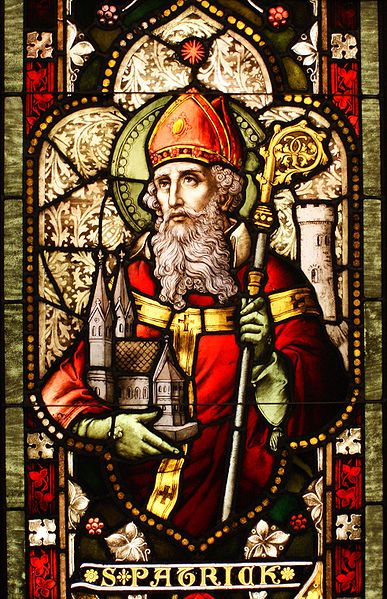
St Patrick in Stained Glass
What do we know about Saint Patrick?
Since the 8th century, Patrick has been known as the patron saint of Ireland, but he was not born on 'the Emerald Isle'. He was born in Britain, probably in or around 387 AD. He gives his birthplace as 'Banna Venta Berniae', but this has not been definitely identified. Whilst checking the Internet, I have seen the following suggestions: Birdoswald in Cumbria, Barnstable in Devon, Banwen in Wales, Kilpatrick in Scotland and even Boulogne-sur-Mer in France. However, it seems most likely that he was born and living in Britain during the Roman occupation of Britain, so he could be termed a Romano-Briton.
According to 'New Advent' (Roman Catholic), Patrick 'had for his parents Calphurnius and Conchessa. The former belonged to a Roman family of high rank and held the office of decurio in Gaul or Britain. Conchessa was a near relative of the great patron of Gaul, St. Martin of Tours. Kilpatrick still retains many memorials of Saint Patrick, and frequent pilgrimages continued far into the Middle Ages to perpetuate there the fame of his sanctity and miracles.'
http://www.newadvent.org/cathen/11554a.htm
Kilpatrick, near Dumbarton, in Scotland, is very close to the Roman Antonine Wall, and I have read that Patrick's father was a Roman official there, but this wall was only in use from the 140s until the 160s, when Hadrian's wall again marked the most northerly reaches of the Roman Empire.
Letters
Two of Patrick's letters still exist. They are written in Latin and are considered genuine (the 'Confessio' and the 'Epistola' to Coroticus). From these, particularly the latter, historians have gained an idea of Patrick's life story. He seems to have come from a Christian family, with his father, Calpornius, being a deacon and his grandfather, Potitus, a priest but he writes that 'I did not, indeed, know the true God; and I was taken into captivity in Ireland with many thousands of people, according to our deserts, for quite drawn away from God, we did not keep his precepts, nor were we obedient to our priests who used to remind us of our salvation'.
Patrick's Youth
Patrick probably spent his youth somewhere in 'England' (it was not then known as England, since this was before the arrival of the Angles and Saxons) but, at the age of about 16, he was captured at his family's farm or villa and enslaved by raiders from Ireland, who took him back home with them. After about 6 years of slavery, praying, and working as a herdsman, he managed to get to a ship and escape back to England ~ and to his family. Patrick found God and eventually became a Bishop in the Christian Church ~ and he returned to Ireland to work in the North and West of the isle. He felt a calling. Indeed, he wrote that he, literally, heard himself being called, in a vision : "We appeal to you, holy boy, to come and walk among us again". There were no monasteries in Ireland at this time and it is not known whether he had connections with any church in that country.
Patrick's Writing
In the 'Declaration' he writes about being put on trial, following accusations made by Christians, which are not clear, but which seem to concern money ~ since he states that he refused to accept certain payments and that he returned certain gifts. He indicates that he baptised thousands of new Christians, ordained many priests and converted women who became nuns.
He writes: "I boldly declare that my conscience does not reproach me here or hereafter. God is my witness that I have not lied in the statements I have made ..... I testify in truth and in joy of heart, before God and His holy angels, that I never had any motive, except the Gospel and His promises, for ever returning to that nation from whom on a former occasion I with difficulty escaped."
The 'Epistola' is an open letter to Coroticus telling him that Patrick has excommunicated him, for taking some of his Christian converts into slavery.
Being, alone in a foreign land left Patr
Death of Patrick
Patrick may have died in or around 461 AD, but dates decades earler and later have also been suggested. The 17th March ~ his Saints Day ~ is the assumed date of death. Legends and stories have become intertwined with assumed facts to give us a Saint Patrick 'mythology ~ including the idea that Ireland is without snakes because St Patrick banished them.
Saint Patrick

From: St. Patrick's Day Facts: Shamrocks, Snakes, and a Saint (National Geographic Daily News)
Quotes
Until the 1970s, St. Patrick's Day in Ireland was a minor religious holiday. ... "St. Patrick's Day was basically invented in America by Irish-Americans," Freeman said. [Classics professor Philip Freeman of Luther College in Iowa]
Eighteenth-century Irish soldiers fighting with the British in the U.S. Revolutionary War held the first St. Patrick's Day parades. Some soldiers, for example, marched through New York City in 1762 to reconnect with their Irish roots. Other parades followed .... in Boston, Philadelphia, and Chicago, primarily for flourishing Irish immigrant communities. "It becomes a way to honor the saint but also to confirm ethnic identity and to create bonds of solidarity," Meagher said. [Timothy Meagher ~ expert on Irish-American history at Catholic University in Washington, D.C.]
*
"According to St. Patrick's Day lore, Patrick used the three leaves of a shamrock to explain the holy trinity: the Father, the Son, and the Holy Spirit. Today, St. Patrick's Day revelers wear a shamrock out of tradition. But people in Ireland hoping to wear an authentic shamrock may be out of luck this year. "We have had a long and hard winter, which is still not fully over," John Parnell, a botanist at Trinity College Dublin, noted via e-mail. The growing season has also been affected, he said."
http://news.nationalgeographic.com/news/2010/03/100316-st-patricks-day-facts-shamrocks/
Saint Patrick's Day 2010 - Birmingham UK
17th March. Saint Patricks Day.
The day is celebrated all over the world ~ especially where the Irish have settled ~ and one of the biggest Saint Patrick's Day parades occurs annually in Birmingham, Engand. It's not, necessarily, on the day, of course, it's always on the nearest Sunday. And in 2010, that was March the 14th.
Only Dublin and New York have bigger Saint Patrick's Day events than does Birmingham ~ where Guinness flows, Irish dancers entertain, traditional music is played and the 'craic' can be enjoyed by all.
Traditional music was also played in the streets on the afternnoon of Saturday the 13th.
*
In Irish, Saint Patrick is Naomh Pádraig.
'Irish Birmingham: A History' - by James Moran
'Birmingham has long been shaped by its Irish residents. The migration caused by Ireland's potato famine gave Birmingham the fourth highest Irish-born population of any English or Welsh town in the mid-1800s'.
Amazon Product description for 'Irish Birmingham: A History' by James Moran
A Saint Patrick's Day Children's Book

St Patrick's Day Festivities in Birmingham
More than 80,000 people enjoyed the carnival atmosphere in Birmingham's
Irish Quarter (around Digbeth and Deritend - some of the oldest areas of Birmingham), where the streets were closed to accommodate the parade.
There were floats, bands, dancers, town cryers and tractors ~ plus
several stalls, side shows and a fun fair. Also plenty of food, drink,
sunshine ~ and green clothing! Irish eyes ~ and everyone else's eyes ~
were smiling indeed! All for 'Paddy's Day'!
This year the theme
was all encompassing, so, as well as Irish music and dance, Samba bands
played and there were displays of 'Bollywood' dancing and Bhangra and
Chinese Displays. Birmingham is a multicultural city and the fun
reflected that. Later there was entertainment from a variety of rock,
folk and blues bands. What would Saint Patrick have made of it all?!
Before
the parade, there was a special mass, at Saint Anne's RC Church in
Birmingham's Alcester Street ~ the church that was attended by JRR
Tolkein, with his mother, when he was a young child.
The
festivities did not end on the day, either, with more events coming
along during a festival lasting until Saint Patrick's Day, itself.
Irish theatrical, film and literary events had been planned, with a
special story-telling event to close the festival on the evening of
Saint Patrick's Say.
Birmingham Irish

Birmingham Irish: Making Our Mark by Carl Chinn
"Birmingham Irish: Making Our Mark" Shows how and why the Irish community in Birmingham developed. It shows how the community enriched the social, cultural, commercial and political life of the city from the 1820s to the 1990s. It presents the varied experiences of the Irish in Birmingham, as others saw them and how they saw themselves.
Quote from:
http://birmingham.gov.uk/cs/Satellite?c=Page&childpagename=Lib-Libraries%2FPageLayout&cid=1223092587783&pagename=BCC%2FCommon%2FWrapper%2FWrapper
British Isles

Buy Saint Patrick Books + Novelties Online

Other Saint Patrick Hubs
- If Your Irish Come Into The Parlour. !
By Dim Flaxenwick - Life and Confession of St. Patrick: Captivity in Ireland
First part of the story ~ By Jane Grey - St. Patrick's Story and Confession: Evangelism of Ireland
A Continuation ~ By Jane Grey
More of My 'Saint' Hubs
Saint Patrick Info:
- Shamrock - Wikipedia, the free encyclopedia
Shamrock info - St. Patrick's Day Facts: Shamrocks, Snakes, and a Saint
St. Patrick fact and fiction - BBC News - Thousands at St Patrick\'s parade in Birmingham
Thousands attend St Patrick's parade in Birmingham. - Birmingham Mail - News - Birmingham News - Birmingham St Patrick\'s Day Parade: 50,000 set to attend
Birmingham -St Patricks Day parade. - RootsWeb: GENIRE-L About Patricius son of Calpornius son of Potitus...
His letters - BBC - Religions - Christianity: Saint Patrick
The history of Saint Patrick from the BBC